Showing posts with label folk tale. Show all posts

Thursday, March 29, 2012

Luca Day Witch III


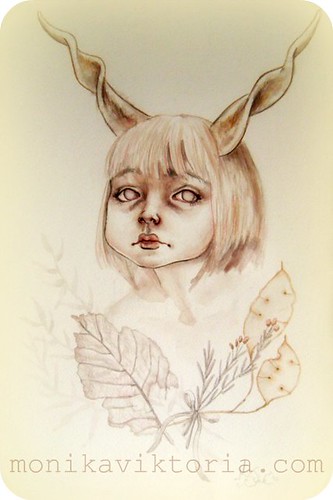
I felt I needed a third Luca Witch to complete a small set of three for my solo exhibition (still untitled). 

I discarded my idea of the third witch being older, and decided to instead depict a very young girl - continuing my commentary of social outcasts and strangers being labeled as witches in small, paranoid communities. How young can a witch be? When does she become a witch? Or is the child of an outcast already born branded as such?

Wednesday, March 7, 2012

The Bandit Leader


The LAST of my “Hungarian Folktales” inspired illustrations, ready for my May solo exhibition.

I introduce the Bandit Leader, from a folktale called “The Prince of the Three Wild Beasts”. In the tale, as the old King lays dying, he makes his son promise that he will not marry until he finds a suitable husband for his younger sister. The princess however is not an overall sympathetic character, and no suitors arrive to ask for her hand. Fed up the prince announces he is going to go adventuring and see the world. Upon her requests, the prince takes his sister with him. On the road they are accosted by a troupe of bandits, but the prince slays them all with ease – he spares the leader, who leads them to his castle in the woods. Here the Bandit Leader is locked in a room as a prisoner – but not before the princess falls for his good looks. Through the keyhole he wins her heart with beguiling promises and flattery, and convinces her to try and kill her brother. However, with his kind heart the prince wins the unfailing loyalty of the three wild beasts sent to kill him, who at the end of the tale tear the Bandit Leader to shreds for attempting to murder their master. I wanted to depict my Bandit as a handsome, though dangerous faced young man.

After completing 30 folktale illustrations, (25 within the past four months - as well as various other side projects), I feel I have done this theme justice, and am ready to move on to a new body of work.

Monday, December 19, 2011

Luca Witch


In Hungary the 13th of December is celebrated as Luca Day, a day when evil walks amongst us, similar to the Western "All Hallows Eve".

On Luca Day the young men of the town would start to build the Luca Chair. Each day up until Christmas Eve you had to work on a particular part of this chair, which eventually had to be constructed and carved out of 13 different types of wood, over 13 days. On Christmas Eve the guys would smuggle the chair into midnight mass hidden beneath their coats. Superstition was that if you stood on the chair at midnight you would be able to see who amongst those present was a witch. The Witches on this evening would grow long horns, invisible to the naked eye. Because of the horns they would have to duck or bend over as they entered the gate of the church. The person who stood on the Luca chair would be able to see the horns and identify the witch – then they would have to run home (screaming and hollering I imagine) lest the witch, enraged that she/he’d been discovered tore them to shreds. By dismantling and burning the Luca Chair in the fire you symbolically burned the witch – the little pieces of wood were rumoured to shriek in the fire as the evil spirits were burned.

I loved the imagery of the witches sprouting horns, and am working on a small series of Luca Portraits inspired by this tradition. The horns here are based upon a traditional breed of giant grey cattle confined to Hungary known simply as "Grey Cattle " (Szürke Marha).

Wednesday, December 14, 2011

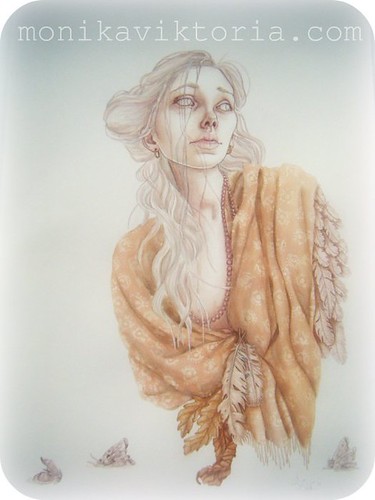
The Milk-Eyed Seer


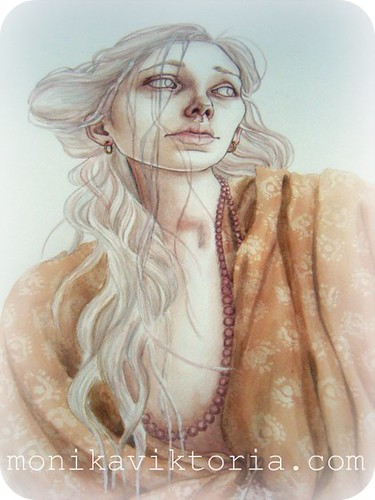
Sometimes I don’t actually illustrate a particular character in a particular folktale, but either take inspiration from the essence of the tale, or wander down a completely different path. This was such a case.
When working out the composition for The Witch’s Daughter, I couldn’t decide between a portrait, or a full-body composition. I ended up choosing to depict the entire pose – I felt it was very important in order to convey the situation the girl found herself in – flung to the ground, awaiting her unfair fate.
The idea of a portrait however, nagged at my mind. I didn’t want this to be “The Witch’s Daughter #2”, but I struggled to find a suitable folk-tale to slot her into. The closest I came was a witch who traded specifically in eyes, and had a little shop set up in town. When a poor florist finds a blinded girl weeping by the road he takes her home, and goes to the witch to buy a pair of eyes for the girl. 


Imagery of blind girls, milky eyes and witches began to meld together in my imagination. Once I finished painting her I felt she needed something a little more –she wasn’t eerie enough. I thought of the most horrible thing I could – moths. Not scary enough yet. Dead moths. Perfect.

 
In the end I don’t think she turned out so horrible and eerie anyway – which I am glad about. I prefer to show the proud and human side of the “ghastly” characters in traditional folktales, the ones you are supposed to recoil from in revulsion simply because they are different from the “common folk”. I also wanted to show that the ugly old blind woman was once young, able to see what you and I cannot.


Saturday, December 10, 2011

The Gallant Swan's Little Sister


In this particular folktale the King has to leave for war. During his absence the Queen gives birth to seven children (at once, I’m presuming, and of course, they are all his, no shenanigans you know!!) Six boys and one girl. The nursemaid of course, is an evil witch, and replaces the children with seven dog pups. The babes are taken into the woods where they are to be killed, but neither the witch’s son nor daughter is able to carry out the grisly task. Instead the daughter pities them and takes away their magical silver necklaces, which makes the children turn into swans. But she misses one, who is raised by a kindly old hermit into a valiant young knight. When he comes of age he goes to his parents kingdom, to find that his mother has been imprisoned after being accused of being a witch (how else to explain the fact she gave birth to pups instead of babes?) He explains the truth, the witch is killed, but only 5 of the 6 stolen chains are found. The royal family head down to the pond in the woods, and the chains are placed upon the necks of the swans, who all turn back into their rightful forms – except the youngest son, who has to remain a swan without his chain. They leave the swan-lad in the pond, and all return to the castle lamenting and crying. Every day his sister visits him, for she liked him the most. Pitying him, she removes the chain from her own neck and places it around his, and takes his place as a swan.
The tale gets rather complicated and winding from there on, but of course at the end everything is made right and they all live happily ever after.

I imagined the princess as quite a pitiful little character – full of love and care, but lacking any sense of self-worth. Although she has the biggest heart and sacrifices herself to free her brother, I think it is sad (but all too usual in folk tales) that a girl’s life is worth less than a boy’s.

The Witches Daughter


I wrote a little bit about this character here, but let me introduce you to her properly.


In many of the folktales I’ve been reading I kept meeting this unfortunate character – the witches’ daughter. Simply because she is the daughter of a “witch” (read that as an old woman living on her own in the woods, ostracized by her community, efficient in the use of healing herbs and potions, perhaps grown bitter and cranky after a long life of ill treatment) she too is destined to an ill fate of being loathed and feared.
The princesses and daughters of rich barons all get wedded off to princes and dashing knights, to continue living their comfortable lives of wealth and privilege. The witch takes pity on her forlorn daughter, and uses her magic to make a prince fall in love with her. When the ruse is uncovered, everyone is horrified and furious – both the witch and her poor daughter are ruthlessly killed (sometimes in quite violent and barbaric ways) for having tricked the gentry. The prince in question marries a princess, and everyone lives happily ever after.

 
I imagined the terrible moment when the miserable girl awaits her cruel fate, destined from birth simply because she was born.

Thursday, December 8, 2011

Pencil and Paper


Usually I can’t wait to start painting a piece after I have finished with the drawing. I’ve gotten to the stage where I feel comfortable knowing that I can make the picture come to life with watercolours, layering translucent wash upon wash to build up a rich body of colour.

Sometimes, however, when I finish a piece that I feel particularly moved by…. I can almost not bear to.


This forlorn little waif will become “The Witches Daughter”. I have a soft spot for those poor unfortunate characters that are destined to be hated by “the good guys” in folktales. Just because her mother is a witch (what does that mean anyway – simply that she is an old woman who has been ostracized by her community because she is ‘ugly’ and perhaps knows how to efficiently use healing herbs and potions) she is destined herself to be feared and loathed, never to be accepted into the inner circle of fairies and princesses and dashing knights.

I felt very sad for this girl as I was drawing her. 
I hope I can do her justice and show her unique beauty once I begin to paint her.

Monday, December 5, 2011

My Sweet Mother’s Rose Tree


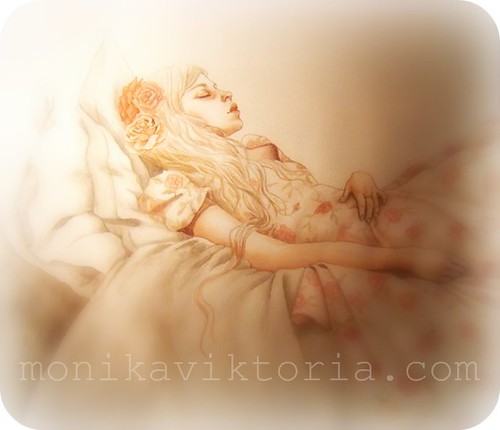
Something hopelessly romantic from me again :-}

 
Almost every Hungarian folksong will open with a verse somehow relating to nature, and references to flowers or birds often allude to the girl being sung about. One of my favourite songs opens with the line: “My Sweet mother’s rose tree.” Further along in the same song the two lines that inspired this piece translate roughly as: 

“I would recommend for everyone, that dreams are better than love,
Because dreams bring you calm, whereas love is only heartache.”

Édesanyám Rózsafája
“Mindenkinek azt ajánlom, a szerelemnél jobb az álom,
Mert az álom nyugodalom, a szerelem csak szív fájdalom.”


I’ve happily become acquainted with a fantastic local band here in Győr called Arabona, who re-work a lot of traditional Hungarian folksongs when they perform, and this one really wrung my heart - like any good hapless romantic. When I am painting I always listen to music, and I find that often what I am listening to will begin to inspire the mood of the piece inadvertently. Quite often a line from a song will end up becoming the title because the two can no longer be separated for me. Whilst I was painting this one I was listening to Florence and the Machine, and another verse caught my attention that seemed equally fitting:

“No more calling like a crow, for a boy, for a body in the garden.
No more dreaming like a girl, so in love, so in love with the wrong one.”


I’m debating painting the shadow of a rose tree spreading out above her. But we will see. Hope you like her!